Le Sommet de Rome marque le lancement du « catholicisme africain »
Le Sommet de Rome marque le lancement du « catholicisme africain »
Crux || Par John L. Allen Jr. || 26 mars 2017
Un sommet des dirigeants catholiques africains à Rome du 22 au 25 mars a été beaucoup trop complexe pour résumer, mais peut-être le meilleur coup de couteau à une grande prise de vue est qu'il a marqué le lancement du «catholicisme africain 2.0: Plus généralement orienté, plus honnête sur lui-même, et plus équilibré dans son jugement de l'autre.
Dans le film classique "The Princess Bride", le personnage d'Inigo Montoya tard dans le film est confronté au défi de raconter l'histoire jusqu'à ce point. Il dit: "Laissez-moi expliquer... Non, il y en a trop. Laisse-moi résumer."
J'ai eu une sensation similaire dans le sillage d'un 22-25 mars Sommet des dirigeants catholiques africains à Rome « Théologie chrétienne africaine : mémoires et mission pour les 21m Century », parrainé par le Centre d'éthique et de culture de l'Université Notre-Dame.
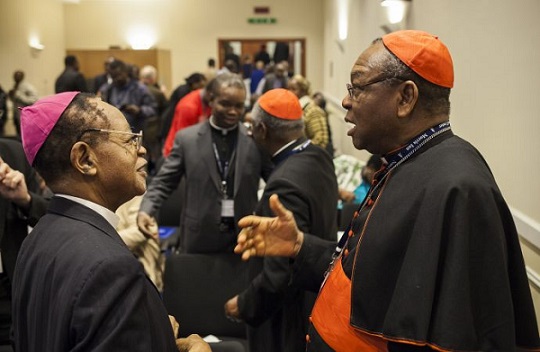
L'événement a réuni quatre cardinaux, un ensemble d'évêques, de nombreux prêtres et religieux, ainsi que de nombreux théologiens, laïcs, militants, étudiants, et d'autres émouvants et agitateurs de l'Église catholique en Afrique. (Pour être honnête, je me suis demandé qui dirigeait les choses chez moi, puisque toute la structure de pouvoir de l'église africaine semblait être à Rome.)
Après quatre jours, 46 présentations, 14 périodes de discussion, et une avalanche de verbiage, toute tentative d'un résumé complet est une course idiote. Mais dans l'esprit d'essayer de résumer, voici un coup de couteau à elle: Je pense que ce que nous avons vu de mercredi à samedi a été l'émergence de ce que l'on pourrait appeler "catholicisme africain 2.0."
Pendant une bonne partie de la période postcoloniale, l'Église en Afrique a connu deux défis principaux. La première était de suivre le rythme de la croissance astronomique; et la seconde était confrontée aux problèmes sociaux du continent, tels que les conflits armés, la pauvreté chronique, la dégradation de l'environnement, les conflits ethniques et tribaux et le VIH/sida.
Aucun des deux défis n'a diminué. Cependant, ce qui a émergé du sommet de Rome est un sentiment de maturité croissante, une conviction que le catholicisme africain est passé de l'enfance et de l'adolescence à l'âge adulte et est prêt à entrer dans une nouvelle phase.
Quels sont les traits caractéristiques du catholicisme africain 2.0? Basé sur la semaine dernière à Rome, au moins trois se suggèrent.
Ad Extra et Ad Intra
Une caractéristique de l'église africaine adulte est un sentiment qu'elle a obtenu une contribution non seulement en Afrique, mais aussi au monde entier et à l'Eglise universelle.
Mgr Tharcisse Tshibangu, évêque de la République démocratique du Congo, a insisté pour que la théologie catholique africaine fasse partie de la conversation mondiale.
"Ce n'est pas seulement une question de théologie africaine pour les Africains," Tshibangu a dit mercredi, "mais une théologie qui est valable pour un et pour tous."
Dans un entretien Crux, le cardinal Francis Arinze du Nigeria, un poids lourd de longue date du Vatican qui s'est retiré, a déclaré que l'émergence des prélats africains comme protagonistes dans l'église mondiale, y compris les rôles clés qu'ils ont joués dans les deux récents Synodes des évêques sur la famille, était un résultat organique de la croissance de l'église africaine.
« Les Evêques et les cardinaux ont plus d'expérience de ce qu'est l'Église, et ils sont donc tenus de contribuer davantage », a-t-il déclaré. "C'est juste un développement normal de la providence divine."
Une partie de l'image peut être que de nombreux prêtres et religieux africains servent maintenant à l'étranger, il ya donc déjà un sentiment que l'Eglise universelle a besoin de l'Afrique. Une partie peut aussi être un sentiment que le catholicisme africain a généré un corps profond de réflexion théologique et de pratique pastorale, dont il est fier à juste titre.
Quoi qu'il en soit, il y avait un fort sentiment à Rome qu'un « moment africain » dans l'Église catholique est arrivé. Sans se retirer des défis de l'Afrique, l'Eglise sur le continent apparaît de plus en plus prête à jouer un rôle de premier plan sur la scène mondiale.
Honnêteté et autocritique
Dans le passé, les dirigeants catholiques africains devenaient souvent défensifs face à toute critique perçue de l'Eglise sur le continent, s'inquiétant qu'elle nourrirait la perception de l'Afrique comme dysfonctionnelle et immature.
Aujourd'hui, cependant, précisément en raison d'un sentiment croissant de confiance en soi, les catholiques africains semblaient plus enclins à reconnaître honnêtement leurs échecs et leurs défauts, sachant qu'il ya suffisamment de force dans leurs églises pour faire face à la tempête.
Le père nigérien Paulinus Odozor, l'organisateur du sommet, a souligné entretien avec Crux.
« Vous devez être prêt à laver votre linge sale en public, où tout le monde peut voir », a-t-il dit. « Si l'Afrique veut être prise au sérieux en tant qu'acteur, elle doit être honnête sur elle-même.
"Nous ne voulons pas juste que les gens entendent les choses merveilleuses que nous faisons. Nous voulons aussi que les gens entendent les choses terribles que nous faisons, et les choses que nous ne faisons pas bien », a-t-il dit.
Ce point a été renforcé tout au long de l'événement, comme l'attestent les exemples suivants.
-
Mgr Godfrey Onah du Nigeria a néanmoins déploré que, bien que l'Afrique antique ait produit de grands pères de l'Eglise, elle est aujourd'hui plus connue pour les guérisseurs de foi et les centres de miracle.
-
Le père Ludovic Lado, jésuite de Côte d'Ivoire, a rapporté que certains prêtres catholiques en Afrique non seulement pratiquent la sorcellerie, mais jettent des sorts les uns contre les autres.
-
Soeur Maamalifar Poreku du Ghana non seulement se plaignait que les femmes de l'église africaine sont souvent réduites à ne rien faire de plus que de nettoyer les draps paroissiaux, mais que le sommet de Rome lui-même n'avait pas vraiment donné beaucoup d'espoir que les choses changeraient.
Quoi que l'on fasse de ces points, les gens qui les livraient n'avaient aucun sentiment apparent que cela porterait atteinte aux perspectives catholiques africaines. La prémisse non déclarée semblait être, « Nous avons accompli assez que parler de ces choses ne va pas changer fondamentalement l'équation. »
Équilibre avec l'autre
Lorsque le catholicisme africain a pris racine pour la première fois, il y avait un sentiment compréhensible que l'évangélisation était fragile, et donc, parfois, une forte hostilité envers tout ou quelqu'un qui semblait menacer le catholicisme.
Dans le contexte africain, cela s'est généralement traduit par une vive rivalité avec deux expressions de l'« autre » religieux : l'islam et le pentecôtisme.
Alors que de nombreux catholiques aujourd'hui restent méfiants des deux, et pas sans raison, cela s'accompagne de plus en plus d'une capacité à reconnaître le bien des deux côtés de la clôture, et même à admettre avec tristesse que la concurrence pour le cœur et l'esprit peut en fait être saine.
L'évêque Matthew Kukah, de Sokoto, dans le nord du Nigéria, une partie majoritairement musulmane du pays, est devenu l'un des principaux interlocuteurs du catholicisme africain avec l'islam, faisant de la coexistence pacifique l'exception.
"Ce que les gens appellent conflit chrétien-musulman, il n'y a rien d'inévitable à ce sujet. Je pense que les médias occidentaux ont construit cela, et c'est très populaire », a-t-il déclaré dans une interview de Crux.
« Ce que nous appelons vraiment la violence entre chrétiens et musulmans au Nigeria, c'est l'échec de l'ordre public », a-t-il déclaré. « Beaucoup de problèmes qui ont conduit à la violence ont eu très peu à voir avec la religion en soi. »
Quant aux pentecôtistes, Il y a eu beaucoup de discussions. au sommet de Rome sur la façon dont ils "lure" les gens loin de l'Église catholique – leur donnant des emplois, en organisant des services de rencontres pour leur fournir des conjoints, et en visitant les séminaristes et les prêtres qui défection.
D'autre part, plusieurs participants ont également admis que le défi pentecôtiste est en fait sain, parce qu'il force le catholicisme à « se réveiller ».
« Cela nous a fait comprendre que nous ne pouvons pas tenir notre peuple pour acquis », a déclaré Obiageli Nzenwa, une laïc catholique et consultante indépendante en ressources humaines à Abuja, au Nigeria.
Elle a dit qu'elle espérait que le boom pentecôtiste pourrait inciter le catholicisme à accorder plus d'attention à l'importance de la formation et de l'aide aux femmes, car elles constituent l'épine dorsale de l'Église africaine.
Le « catholicisme africain 2.0 » semble être plus sûr de soi, plus honnête sur lui-même, et moins donné aux jugements instantanés sur l'autre.
Étant donné tout ce que la version 1.0 a accompli, y compris façonner la communauté catholique la plus dynamique et enthousiaste partout dans le monde, il sera vraiment fascinant de suivre comment la version 2.0 joue.
Source: Crux...