Un an après la présidence Trump, les États-Unis ont une politique étrangère
Un an après la présidence Trump, les États-Unis ont une politique étrangère
Global Sisters Report (GSR) || Par Chris Herlinger || 19 janvier 2018
Un an à la présidence de Donald Trump, des sœurs catholiques travaillant au niveau international disent qu'elles sont devenues frustrées, las et même en colère contre la direction que l'administration de Trump prend les États-Unis dans ses relations avec le reste du monde.
La frustration est particulièrement vive chez les sœurs qui représentent leurs congrégations à l'ONU. En tant que fervents partisans du dévouement de l'ONU à la coopération internationale dans ce qu'ils décrivent comme un monde de plus en plus interconnecté et mondialisé, les sœurs disent qu'elles sont inquiètes et consternées au sujet de l'administration Trump.
"Quand l'intérêt national prime sur le bien commun — Eh bien, c'est un dilemme sans fin aux Nations Unies, » a déclaré Sr Margaret Mayce, une américaine qui représente la Conférence dominicaine de leadership à l'ONU. « Mais c'est à notre visage maintenant. »
Mayce a dit qu'elle ne voulait pas « imposer des gens », mais qu'elle ressemblait de plus en plus aux valeurs de l'ONU en matière de coopération internationale et de responsabilité mutuelle « ne sont pas des valeurs pour l'administration actuelle », a-t-elle dit.
Sr. Justine Gitanjali Senapati, qui représente Congrégations de Saint-Joseph au corps mondial et qui ont exprimé leur inquiétude après l'élection de Trump au sujet de ce que sa présidence pourrait présenter pour les femmes, les personnes qui vivent dans la pauvreté et les migrants, a déclaré que tout moment d'attente possible pour l'administration Trump est terminé.
Dans un entretien avec Global Sisters Report, Senapati a déclaré qu'elle et d'autres devaient défendre la « voix mondiale commune » que représente l'ONU.
« Comment pouvons-nous être silencieux face à l'injustice ? » demanda-t-elle, ajoutant que les sœurs catholiques doivent « prendre position pour ce qui est juste. Nous ne pouvons pas nous taire."
Mayce, Senapati et d'autres sœurs fournissent une longue liste de frustrations avec l'administration actuelle. Il s'agit notamment :
Les Retrait des États-Unis l'accord de Paris sur le changement climatique négocié par l'ONU;
A similaire retrait des négociations sur un ensemble de pactes internationaux sur les migrations et les réfugiés parrainés par l'ONU;
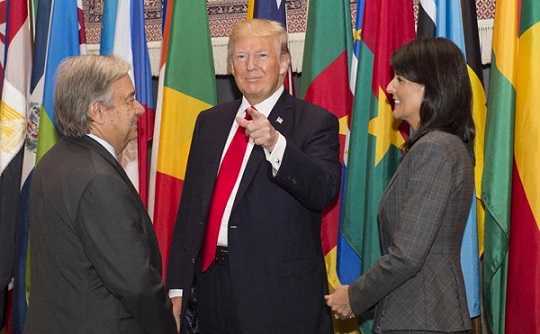
Commentaires de Nikki Haley, ambassadrice des États-Unis auprès des Nations Unies, selon lesquels elle était "prendre des noms" des pays qui ont critiqué les États-Unis pour leur décision de déplacer l'ambassade américaine en Israël de Tel-Aviv à Jérusalem.
Trumps récents commentaires sur l'immigration et ses rumeurs caractérisation brute d'Haïti et des pays d'Afrique en tant que pays « trou de merde » — un terme Trump nie utiliser — ont également alimenté la colère parmi les sœurs travaillant à l'ONU.
« J'ai été personnellement outré par cela », a déclaré Senapati. "C'est raciste. C'est un simple commentaire raciste."
Cette indignation va au-delà des Nations Unies : Dans une déclaration publiée plus tôt cette semaine à propos de Martin Luther King Jr. Day, le Michigan Adrian Soeurs dominicaines n'a pas mentionné Trump par son nom, mais a dit, "Notre sens national de la décence est [être] agressé par un discours public grossier et irrespectueux, et notre sens de l'unité brisé par des mots et des actions qui sèment la haine et la division."
Moins circonspecte était Sr Denise Desil, la mère générale de la congrégation haïtienne de près de 200 membres les Petites Sœurs de Sainte Thérèse de l'Enfant Jésus. Desil, qui vit et travaille en Haïti mais qui voyage fréquemment aux États-Unis, a dit que la réaction de GSR en Haïti aux commentaires de Trump était "shame pour l'être humain [qui] ne sait pas que nous sommes tous les enfants de Dieu. La peau [couleur] ne signifie rien. Nous avons le même sang dans notre corps. Je suis fier de ma couleur. Nous devons respecter les autres."
Pour les sœurs de l'ONU, les commentaires ont simplement plafonné une année d'impatience croissante sur les politiques américaines.
Senapati a déclaré que la décision des États-Unis de sortir de l'accord de Paris sur le climat était particulièrement grave, l'appelant « un danger pour le monde ». Elle a dit qu'il est troublant que le pays le plus puissant du monde « ne puisse pas lire le signe des temps ».
Ce que font les États-Unis, a-t-elle dit, est contraire aux valeurs de l'ONU et crée des ennemis pour les États-Unis à l'échelle mondiale et mondiale.
« C'est alarmant, dit-elle.
Mayce a déclaré que le retrait des négociations sur le pacte migratoire était particulièrement révélateur de l'orientation de la politique américaine.
En 2016, l'administration du président Barack Obama a soutenu la Déclaration de New York, une étape importante vers le débat cette année de deux pactes internationaux, l'un axé sur « un ensemble de principes et d'approches communs » sur la migration globale et l'autre sur les réfugiés.
Déclaration de New York appelle à la protection des « droits de l'homme de tous les réfugiés et migrants, quel que soit leur statut », y compris les droits des femmes et des filles « et à promouvoir leur participation pleine, égale et significative à la recherche de solutions ».
Dans sa déclaration du 2 décembre annonçant le retrait, Haley a salué ce qu'elle a appelé le patrimoine des immigrants américains et « notre leadership moral de longue date en fournissant un soutien aux populations migrantes et réfugiées dans le monde entier. Aucun pays n'a fait plus que les États-Unis, et notre générosité continuera.
« Mais nos décisions en matière de politiques d'immigration doivent toujours être prises uniquement par les Américains et les Américains », a-t-elle déclaré. « Nous déciderons comment contrôler au mieux nos frontières et qui sera autorisé à entrer dans notre pays. L'approche globale de la Déclaration de New York n'est tout simplement pas compatible avec la souveraineté américaine. »
Dans une entrevue avec le GSR, Mayce a déclaré que l'annonce était inquiétante parce que la question des migrations est d'envergure mondiale, et les États-Unis devraient participer à la discussion sur la façon de s'y attaquer.
« Se tirer de là comme si rien au niveau international n'avait à voir avec nous est tout simplement étonnant », a-t-elle dit.
Mayce a qualifié l'actuelle politique d'immigration américaine de inadéquate, notant que les pays « beaucoup plus petits que les États-Unis ».
Mais, a-t-elle ajouté, même si un pays avait décidé de limiter le nombre de personnes admises, "vous devriez toujours être à la table, en essayant de déterminer comment vous pourriez aider. C'est un problème mondial, un phénomène mondial, et chaque pays a un rôle à jouer."
Mayce a blâmé Haley, un ancien gouverneur de Caroline du Sud et fille d'immigrants indiens, pour avoir « suivi » la rhétorique nationaliste de Trump et a dit ensemble, les politiques et les déclarations de l'année dernière « mettent les États-Unis sous une très mauvaise lumière ». (Le 18 janvier, Politico a rapporté que l'approbation mondiale du leadership américain La première année de Trump est tombée à un record de 30%, selon un sondage Gallup.)
Ajouter aux préoccupations: Mission des États-Unis auprès de l ' Organisation des Nations Unies ne semble pas avoir beaucoup d'intérêt pour un dialogue avec les organisations non gouvernementales, ou les ONG, y compris les congrégations de sœurs, a déclaré Sr Teresa Kotturan, représentant des Nations Unies pour les Sœurs de la Fédération de charité.
Communications cohérentes de la Mission américaine — même les sauts d'email réguliers — semble s'être arrêté, a dit Kotturan, qui a appelé la mission américaine "inaccessible".
"Il n'y a eu aucune relation avec les ONG depuis un an. Il semble que ce soit une avenue fermée. (La mission des États-Unis auprès des États-Unis n'a pas répondu à une demande de commentaires.)
Kotturan, Mayce et d'autres ont déclaré Samantha Power, prédécesseur de Haley, s'est félicité du dialogue avec les ONG, même si elles n'étaient pas d'accord avec les politiques américaines. Les sœurs ont dit qu'elles souhaiteraient un dialogue avec Haley.
"Ce qui me manque, c'est la solidarité mondiale, d'entrer dans un dialogue, de se comprendre, afin que nous puissions résoudre un problème et nous associer à la consolidation de la paix et à la sécurité", a déclaré Kotturan.
« Nous voulons construire des ponts », a déclaré Kotturan à propos du travail des ONG et des congrégations sœurs. "L'accent devrait toujours être mis sur la consolidation de la paix dans le monde."
Source: Global Sisters Report...