Déchets : le problème africain, le jésuite togolais interroge
Déchets : le problème africain, le jésuite togolais interroge
Pleins feux. Afrique || Par Jean Amegble, SJ || 15 juin 2018
 Nous sommes souvent amenés à penser que les questions relatives à l'environnement, aux déchets et à la pollution sont un problème pour les nations riches et les grandes multinationales. Dans cette pièce, Jean Amegble, jésuite togolais, interroge ce mythe montrant que, bien que les nations développées puissent avoir beaucoup à expliquer, le problème des déchets est un problème créé par tous, même les plus pauvres.
Quand j'étais la dernière au Togo, j'ai voyagé à l'intérieur de la capitale de Lomé. Le voyage m'a laissé choqué et déçu alors que j'ai été témoin des attitudes négligentes et des actions inconsidérées de mes compagnons de voyage envers l'environnement. J'ai regardé des passagers acheter des paquets de maïs et d'arachides pour les collationner et quand ils ont fini de jeter les sacs en plastique vides hors du bus.
Ce qui m'a choqué, c'est la normalité avec laquelle ils sont apparus à la portée. Il ne semblait pas y avoir de seconde pensée ou de remords. En fait, il semblait qu'ils agissaient assez délibérément, sans se soucier du préjudice potentiel qui était causé.
Peut-être, plus grave que l'acte de détritus, est l'incapacité à comprendre, voire à ignorer volontairement, les effets néfastes que ces comportements collectifs insensibles ont sur la nature. Ma préoccupation est que cette attitude injuste est devenue normale et nous trouvons simplement une myriade d'excuses pour justifier nos actions, en changeant la responsabilité de nous absoudre de toute responsabilité. Certaines des raisons que nous conjurons sont que c'est la responsabilité des gouvernements et qu'il ne s'agit que d'un problème pour les pays du Nord mondial, car les questions de protection et de préservation de l'environnement ne sont pas une préoccupation urgente pour l'Afrique.
Mais en fait, la négligence de l'environnement concerne tous : riches et pauvres dans les pays développés et en développement.
Au cours des dernières décennies, la prise de conscience mondiale des changements climatiques et des questions environnementales s'est considérablement accrue. La fonte des glaciers et la réduction rapide des calottes glaciaires polaires, les pluies torrentielles et les inondations destructrices qui en résultent font un nombre important de morts. Plus récemment, une baleine pilote suffoquée dans le sud de la Thaïlande après avoir avalé plus de 80 sacs en plastique. L'événement a attiré l'attention du monde des médias générant beaucoup de sympathie et de colère juste.
Nous avons également connu de graves sécheresses dans le nord du Kenya et en Afrique du Sud destination touristique, Cape Town. Des inondations mortelles ont eu lieu au Rwanda, au Mali, au Burkina Faso, au Niger et au Sénégal. Le mois dernier, tout un village kényan a été anéanti. Au moins 48 personnes ont été tuées lorsqu'un barrage a explosé dans la vallée du Grand Rift pendant des pluies saisonnières inhabituelles. Certains disent que c'est la vengeance de Mère Nature pour le mal séculaire que nous lui avons infligé.
Malgré la prise de conscience croissante de la pollution de l'air, de l'eau et des sols, seuls trois pays africains prennent des mesures radicales contre les déchets non dégradables, en particulier contre l'utilisation de sacs en plastique : le Kenya, le Rwanda et le Maroc. Au Kenya, où la production, la vente et l'utilisation de sacs en plastique sont interdites, vous pourriez être condamné à quatre ans de prison ou à une amende pouvant aller jusqu'à 40 000 dollars si vous êtes pris.
Cependant, dans mon propre Togo, et dans la plupart de nos pays africains, d'innombrables décharges en plein air sont remplies d'un mélange de déchets électroniques, ménagers, toxiques et bio dangereux. Je me rappelle quand, au lycée, j'ai passé un mois entier avec mon père et mon frère à nettoyer l'avant de notre maison jonchée de sacs en plastique et de bouteilles de verre.
A Lomé, notre peuple, et surtout les plus pauvres d'entre nous, est encore à l'écart de leurs maisons. Ils se débarrassent de leurs déchets personnels la nuit, en jonchant clandestinement leurs rues, ce qui les transforme en grands lieux de débarras.
La culture de l'utilisation de poubelles pour les déchets est une habitude douloureusement lente à instiller, à tel point qu'elle semble une poursuite futile. Mais, aussi longtemps que je me souvienne, pendant mon enfance, mes parents nous puniraient si nous demandons des sacs en plastique lors de l'achat d'épiceries. Ils nous diront de prendre des assiettes de la maison pour "emballer" ce que nous avons acheté. Alors, pourquoi cette insouciance a - t - elle pris une telle main?
J'entends souvent dire que la protection de notre environnement est une nécessité et un défi qui touchent les pays développés, en particulier ceux des continents nord-américain et européen. C'est en partie vrai. Ce sont les grands pollueurs. Leurs industries produisent une quantité disproportionnée de déchets.
Selon la Banque mondiale, les pays d'Afrique subsaharienne ne produisent que 5 % des déchets mondiaux. Alors que les États-Unis et l'Europe produisent plus de 50% de nos déchets dans le monde. Pire encore, ils déversent leurs déchets dans les pays africains qui causent de graves problèmes de santé et chargent les Africains de toutes sortes de maladies. Bien que, il faut le dire, les Africains ne puissent pas être absolus de toute responsabilité pour les déchets électroniques et ont, eux-mêmes, beaucoup à blâmer.
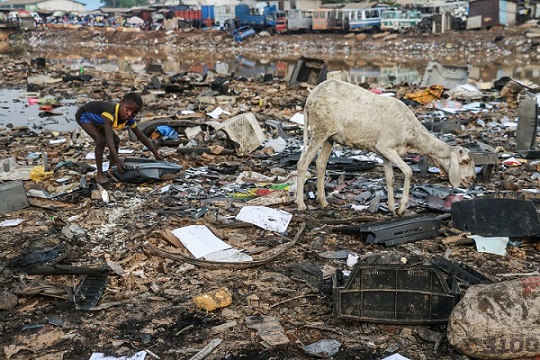
Au Ghana, la plus grande décharge de déchets électroniques (e-déchets) est la célèbre Agbogboshie, une décharge d'environ 20 acres au cœur d'Accra, la capitale de la République. Selon un rapport de 2017, Le Moniteur mondial des déchets électroniques, 44,7 millions de tonnes métriques de déchets électroniques ont été produites en 2016 seulement et seulement 20 % d'entre eux ont été recyclés de façon responsable. Plus effrayant, ces statistiques ne tiennent compte que des déchets électroniques documentés, qui ne représentent que 20 % du total mondial des déchets électroniques.
Selon le Programme des Nations Unies pour l'environnement (PNUE), les déchets électroniques déversés au Ghana et dans d'autres parties de l'Afrique de l'Ouest sont en partie dus aux importations illégales de biens électroniques usagés, en particulier en provenance des Amériques et d'Europe riches. Les entreprises électroniques font souvent entrer leur électronique inutilisable en Afrique. En 2009, près de 215 000 tonnes d'électronique ont été introduites en contrebande au Ghana. Il est nécessaire que la protection de l'environnement commence par le renforcement des lois afin d'empêcher les grandes et riches entreprises qui portent atteinte à la terre et à la santé des pauvres.
Malheureusement, aujourd'hui, les lois et les politiques sont toujours conçues pour protéger les riches plus que les pauvres. De plus, nous nous précipitons et nous poussons à signer des accords et dépensons beaucoup d'argent pour tenir et assister à des conférences, généralement dans des endroits exotiques, qui tentent de régler les problèmes brûlants entourant le changement climatique. Néanmoins, les efforts de la communauté internationale, bien qu ' louables, ne sont que de l ' encre sur le papier, et ne se traduisent que peu au mieux, rien au pire. Les actions concrètes attendues de ces lois semblent toujours coincées dans les douleurs de l'accouchement, en attendant leur naissance.
De retour à Lomé, surtout à Agoè, la décharge se développe rapidement et commence à empiéter sur les maisons des habitants. Les odeurs de nausée et de compromis pour la santé chassent les gens de leur propre maison. Les enseignants sont forcés d'abandonner leurs élèves dans leurs salles de classe alors qu'ils échappent à l'air pur.
Le problème est encore plus grand. Les décharges ouvertes deviennent souvent la seule source de revenus pour les plus pauvres qui vivent à proximité. Ils utilisent la décharge pour trouver de la nourriture, des articles électroniques et d'autres "recyclables" à vendre. Compte tenu de la situation précaire des décharges, les familles envoient souvent leurs plus jeunes membres plus agiles dans les déchets. Cela soulève évidemment toutes sortes de questions sur le traitement des enfants – mais ils n'ont pas le choix s'ils veulent gagner leur vie.
De plus, le développement global de l'Afrique pourrait être freiné encore davantage à mesure que les générations futures seront compromises par les effets néfastes de leur rumming non protégé, les exposant directement aux polluants toxiques dans le sol, l'eau et les fumées des déchets brûlés. Je crois que la protection de notre terre n'est pas un problème pour les générations futures, comme certains voudraient le dire, mais une situation qui pourrait entraîner l'extinction de notre génération actuelle.
Cependant, l'image n'est pas entièrement sombre et sombre. Là où les gouvernements échouent, les associations de femmes et d'autres petits groupes communautaires font de leur mieux pour établir un nouveau système de collecte et de transformation des sacs en plastique. Les sacs en plastique, qui étaient un instrument de la mort, deviennent l'or noir des communautés vulnérables.
Début 2010, le Français Walter Gauvrit et le Togolais David Chateau-Gaitou, ont créé une association appelée "Addel" afin de transformer les sacs en plastique en pavés. En mélangeant le plastique fondu avec le sable, ils ont créé un nouveau type de goudron de pavage adapté à la construction de la route. 20 kg de déchets sont nécessaires pour faire 5 kg de goudron. À Bobo-Dioulasso, au Burkina Faso, une association de femmes GAUCHE (Groupe d'Action des Femmes pour la Relance Economique du Houet), collectent des sacs en plastique depuis 18 ans afin de fabriquer des vêtements, sacs à dos, étuis informatiques, soucoupes, colliers et porte-clés. Les objets sont vendus partout au pays et donnent du travail à des centaines de femmes.
Toutefois, ces associations ne couvrent qu'une petite superficie pour la collecte de sacs en plastique. Ils manquent souvent d'investissements financiers et, là où de grands investisseurs se sont impliqués, ils offrent de bas salaires pour ce qui est un travail épuisant. Ces associations luttent également pour survivre, surtout que beaucoup boycottent leurs marchandises parce qu'elles les trouvent trop chères.
Je demande une meilleure compréhension de notre rôle de gardien de l'environnement. En tant que gardiens, nous sommes appelés à trier soigneusement nos déchets, à réfléchir deux fois avant de gaspiller de la nourriture, à boycotter tous les sacs en plastique, à soutenir les petites associations de recyclage en achetant leurs biens et à promouvoir les efforts de ces associations dans nos communautés. Grâce à ces petites actions, nous pouvons être d'une grande aide pour l'humanité, maintenant et pour les générations à venir, et surtout pour les plus pauvres parmi nous.
Source: Pleins feux. Afrique...