Meeting of Continental Synodal Bodies: A sign of support and encouragement
A sign of support and encouragement
Meeting with the leaders of continental bodies
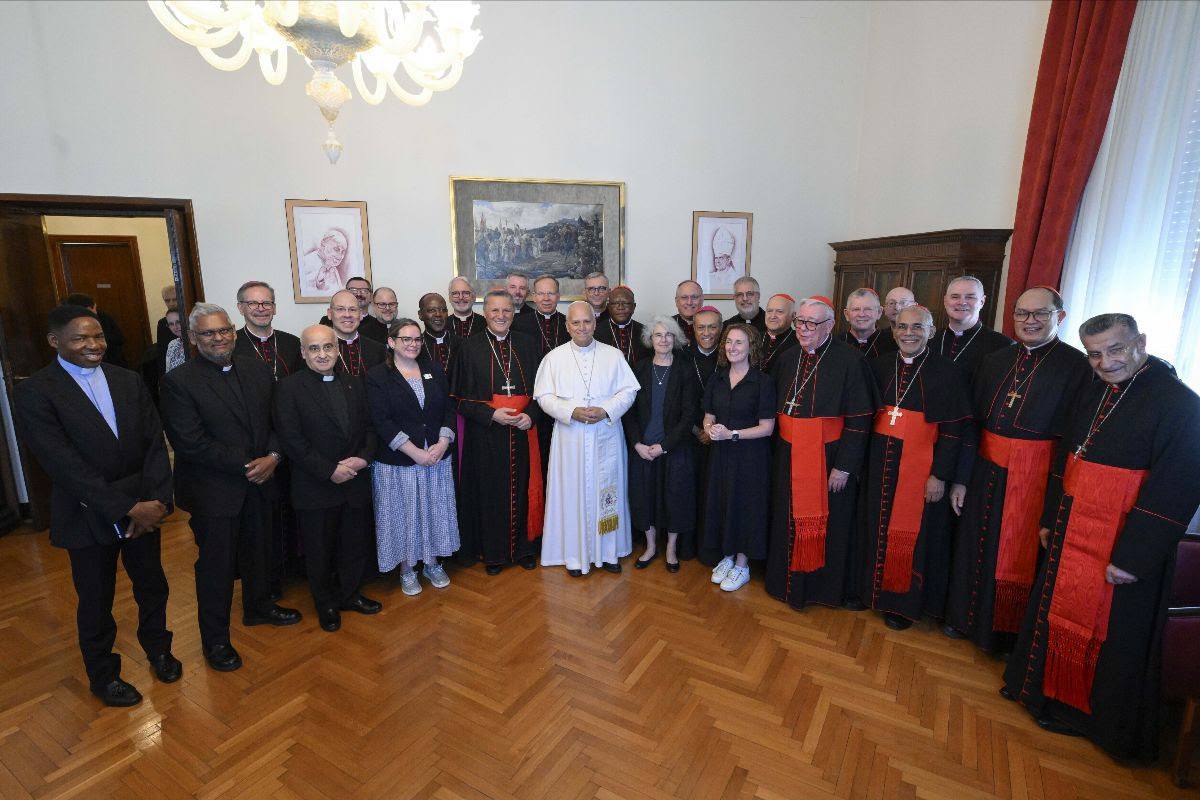
“The meeting with the Holy Father was for all the participants a powerful sign of support and encouragement as they continue their work for the Church’s synodal conversion.” With these words, cardinal Mario Grech, Secretary General of the Synod, concluded the meeting of the leaders of the continental bodies (CELAM, SECAM, FABC, CCEE and FCBCO).
The private audience with Pope Leo XIV brought to a close three days of work (23-25 June 2026) involving representatives from Latin America, Africa, Asia, Europe, Oceania, the Middle East and North America, together with the coordinators of the continental synodal teams.
The leaders of the continental bodies gathered in Rome to reflect together on the implementation phase of the Synod in light of the recent publication Towards the Assemblies 2027-2028: Stages, Criteria and Tools for Preparation.
The meeting opened on Tuesday, 23 June, with an address by cardinal Mario Grech, Secretary General of the Synod, who offered a brief assessment of the journey undertaken so far, highlighting the unprecedented nature of the current synodal process. Across the world, local Churches have launched numerous initiatives — schools of synodality to support formation, symposia, conferences, and processes of listening and communal discernment — to foster the participation of the faithful. The Cardinal’s opening remarks were preceded by an extended time of prayer led by Sr Nathalie Becquart, XMCJ, Undersecretary of the Synod.
The following days were devoted to listening and discernment as participants reflected on this “new” phase of the synodal journey. Centred on the Final Document of the XVI Ordinary General Assembly of the Synod of Bishops, the implementation phase is not simply a continuation of the pre-assembly process. Rather, it marks the beginning of a new journey, one never before undertaken, in which local communities are called to translate the recommendations of the synodal document into their own pastoral and cultural contexts.
Mutual listening
Part of the meeting was dedicated to hearing reports on the principal developments in the implementation of the Final Document across the various continents. Participants shared significant experiences, challenges encountered, unresolved questions and emerging pastoral priorities. The picture that emerged was that of a creative and dynamic Church, increasingly aware of the need for formation, for a deeper synodal spirituality, and for a more committed effort to inculturate the synodal style. Despite widely differing social, cultural and ecclesial contexts, local Churches are working above all to ensure that synodality becomes not merely a one-time event but a permanent dimension of the Church’s life. Financial constraints, limited structures and personnel, and, in some places, geographical challenges, political instability or widespread poverty continue to make the journey more demanding, without halting its progress.
At the heart of the meeting was a reflection on the newly published document, presented by Fr Giacomo Costa, SJ, Consultant to the General Secretariat of the Synod. The document outlines the journey towards the ecclesial Assembly of October 2028 through four successive stages: Recollecting — first semester of 2027, with diocesan and eparchial evaluation assemblies reviewing the implementation of the Final Document; Interpreting — second semester of 2027, through national and regional assemblies of the Episcopal Conferences; Orienting — during the first four months of 2028, through the continental Assemblies, which will produce forward-looking reports; and Celebrating — in October 2028, with the Ecclesial Assembly of the whole Church, gathered in the Vatican with the Holy Father.
Diocesan, eparchial and national Assemblies
Sr Nathalie Becquart then facilitated the working session devoted to the role of the continental bodies and their synodal teams in supporting the diocesan, eparchial and national assemblies. This was complemented by a presentation from Thierry Bonaventura, Communication Manager of the General Secretariat of the Synod, on the role of communication throughout the process.
Participants strongly emphasised that their role is above all one of accompaniment rather than supervision: to foster an exchange of gifts among the local Churches in a spirit of genuine subsidiarity. They also reaffirmed that the various assemblies — from those of the local Churches through to the ecclesial Assembly of 2028 — should not be seen as the final destination of the Church’s journey of synodal conversion, but rather as moments of celebration and discernment, helping the Church to recognise how it is called to move forward.
Continental Assemblies
Before their concluding meeting with the Holy Father, participants devoted the third day of work to the continental Assemblies and their relationship to the ecclesial Assembly of 2028. The continental ecclesial bodies and their synodal teams are already preparing not only for the assemblies themselves but also for the entire process leading up to them, including the formation and accompaniment of those who will take part as delegates. Various assembly models are currently being explored, all with the aim of enabling the broadest possible participation of the faithful.
Source: www.synod.va
French|Version Française : Communique-de-presse_Synode-2026.06.26_FR