Les sœurs aident à élargir la couverture et les soins dans le système de santé modèle du Rwanda
Les sœurs aident à élargir la couverture et les soins dans le système de santé modèle du Rwanda
Global Sisters Report (GSR) || Par Melanie Lidman || 8 mai 2017
L'obscurité dense de la nuit dans le nord rural du Rwanda efface complètement les immenses collines qui entourent le village de Muyanza. Mais perçant cette obscurité complète quelques fois par semaine sont deux pinpricks de lumière, des phares du village seule ambulance. Lorsque quelqu'un a besoin d'une évacuation immédiate à l'hôpital, l'ambulance s'élance hors de la vallée, s'élançant sur une route de terre mal entretenue. Faustin Musabyimana, le chauffeur, prie pour que de fortes pluies n'aient pas emporté les ponts de fortune faits de planches en bois posées sur des ravins profonds.
Cette ambulance est le lien le plus fort entre les villages isolés dispersés à travers les collines vertes et l'hôpital régional du gouvernement sur la route principale.
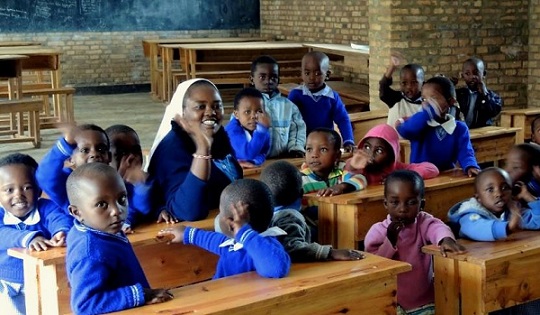
Quatre sœurs kényanes des Petites Filles de la Congrégation Saint-Joseph dirigent le Centre de santé de Muyanza pour le diocèse catholique de Byomba. Sr. Margaret Ekali Londenga gère le centre de santé, avec Sr. Margaret Wanjiku Njuguna, infirmière, et Sr. Rose Wanjiru Kimani, pharmacien, tandis que Sr. Martha Chebon Jeptare dirige une école maternelle catholique. La collecte de fonds pour acheter l'ambulance à leur congrégation internationale a été l'un de leurs premiers projets lorsqu'ils ont pris la direction du centre de santé en 2001.
« Il y a des régions [du Rwanda] où il y a de bonnes communications et des zones fertiles, et elles sont faciles d'accès, et il y a aussi des zones difficiles », a déclaré Londung. Notre spiritualité comme les Petites Filles de Saint-Joseph va aux nécessiteux, aux plus pauvres des pauvres, aux marginalisés. Après que Mère [Superior Licia Rebonato] a visité de nombreux endroits, elle a choisi la plus difficile, la plus difficile, la plus marginalisée, et c'est pourquoi nous avons fini à Muyanza."
Les sœurs missionnaires fournissent plus que des soins de santé. En les voyant comme une pierre de soutien pour la communauté, les résidents ont commencé à accepter les sœurs dans le tissu de leur vie. Le Rwanda a fait d'énormes progrès pour se remettre du génocide de 1994, où 800 000 personnes ont été tuées pendant 100 jours de combats, plongeant le pays dans le chaos et détruisant une grande partie de ses infrastructures.
Dans un pays qui essaie de dépasser l'ombre de sa propre histoire, la confiance peut être la marchandise la plus précieuse. Et la confiance est quelque chose que les sœurs nourrissent lentement, malgré leur statut d'étranger, alors que les résidents de Muyanza commencent à révéler les choses terribles dont ils ont été témoins.
Pendant le génocide, Hutus, qui sont généralement des fermiers, a massacré les Tutsis, l'élite politique qui représente environ 15% de la population et contrôle la majeure partie du gouvernement.
Pour aller au-delà des étiquettes de division, l'actuel président Paul Kagame, un Tutsi au pouvoir depuis 2001, a lancé de nombreuses mesures de réconciliation. Une des mesures de réconciliation les plus visibles est la campagne "Je suis rwandais", qui tente d'effacer les mentions publiques des tribus Hutu et Tutsi, en s'appuyant sur une loi qui rend illégale toute référence aux groupes ethniques, tout en promouvant l'idée d'une identité nationale unique. Mais les réalités qui séparent les deux groupes, historiquement et actuellement, sont plus difficiles à effacer.
Le Rwanda est devenu un « enfant postulant pour le développement de l'Afrique », avec une croissance de 8% du produit intérieur brut au cours des 15 dernières années. Les soins de santé ont été l'un des premiers endroits où profiter de cette évolution. Le pays consacre 24 % de son budget aux soins de santé, selon l'Organisation mondiale de la santé, et nombre des politiques de santé gouvernementales sont efficaces et réussies, comme la campagne de 1 000 jours pour réduire la mortalité maternelle et infantile, dans le but de faire en sorte que chaque enfant atteigne l'âge de 1 000 jours de santé. Selon Le gardien et Recueil mondial de la CIA, le taux de mortalité infantile est passé de 120 décès pour 1 000 naissances en 1998 à 56 décès pour 1 000 naissances en 2016.
Mais le développement n'a pas été uniforme dans tout le pays. Comme les routes asphaltées et les lignes d'électricité sont magnifiquement pavées et qu'elles s'étendent sur de vastes régions du sud et du centre du Rwanda, les zones hutues du nord ont été mal desservies pendant des années.
Muyanza est située dans la région nord du Rwanda, une région à majorité hutue qui faisait traditionnellement partie de l'opposition. La géographie perfide, avec des collines plus raides et des terres moins arables que d'autres régions du pays, ajoute à l'isolement politique. Avec une agriculture difficile et un manque d'investissements gouvernementaux, les résidents ont encore moins l'espoir de sortir de la pauvreté.
Depuis 1976, différentes communautés de sœurs dispensent des soins médicaux 24 heures sur 24 aux habitants de la vallée autour de Muyanza (environ 14 000 aujourd'hui), dans un centre de santé dirigé par le diocèse. Les Sœurs dominicaines ont géré le centre de santé depuis son ouverture en 1976 jusqu'au génocide en 1994. De 1994 à 2001, c'était les Sœurs de Vincent.
Depuis 2001, un groupe de sœurs missionnaires des Petites Filles de Saint-Joseph appelle Muyanza à la maison. Aujourd'hui, quatre sœurs kényanes de cette communauté vivent dans la vallée verdoyante entourée de collines, traitant jusqu'à 1 800 personnes par mois, fournissant des services tels que des vaccins, des soins prénatals et des traitements contre le paludisme. Ils fournissent également des médicaments réguliers à 302 personnes dans les villages vivant avec le VIH/sida.
« Nous sommes entourés de collines, donc nous rejoindre peut prendre au moins une heure », a dit Londung. Auparavant, cela signifiait que chaque fois qu'ils avaient une urgence, ils devaient se rendre à l'hôpital régional pour demander une ambulance. Il faudrait au moins une heure à l'ambulance pour atteindre le centre de santé, s'il y avait une ambulance disponible, et une autre heure pour évacuer le patient, se heurter le long de routes pauvres et enrouler le flanc de la colline.
« Si vous avez une mère qui accouche, nous ne pouvons pas la faire mourir en chemin », a dit Londung. "Alors les sœurs ont fait une initiative — nous avons collaboré avec nos amis, et maintenant nous avons une ambulance."
L'ambulance fournit un lien essentiel avec le monde extérieur, permettant aux sœurs d'amener les patients vers les hôpitaux plus efficacement et de prendre des médicaments et de faire des accouchements.
Le Rwanda dispose d'un régime national d'assurance largement géré qui coûte 3 000 francs rwandais (US$3.60) par personne et par année, quel que soit le revenu ou l'âge. Mais même ce montant est hors de portée des agriculteurs pauvres, qui se présentent sans assurance maladie ni argent pour payer le traitement. Sur les quelque 60 patients par jour, environ trois à cinq sont incapables de payer, a déclaré Londung.
« Si quelqu'un vient au centre de santé, même s'il n'a pas d'argent, il faut protéger cette vie », a déclaré Londung. « Ils peuvent aussi se plaindre [s'ils estiment que le service n'était pas satisfaisant], et vous êtes responsable devant le gouvernement. C'est très positif."
L'engagement des sœurs à traiter tous les patients indépendamment de leur capacité à payer attire également l'attention, tant parmi les patients, dont certains viennent de régions au-delà de Muyanza en raison de la réputation du centre, et du ministère de la Santé.
"Chaque fois que nous avons une réunion au niveau du district, nos patrons se demanderont: ‘Pourquoi Muyanza a beaucoup de dettes et les autres centres de santé ne le font pas? "C'est parce que nous sommes une congrégation religieuse, et nous ne pouvons nier ces services."
Londung'a dit que cet examen est très différent du système de santé kenyan, où elle a formé pour être infirmière.
"[Rwanda] est un petit pays, donc même la supervision du niveau central, ils connaissent Muyanza", a-t-elle expliqué. "Kenya est un vaste pays, et avant que le gouvernement central atteigne la base, il faut du temps. Mais étant un petit pays, tout est à leur portée. »
« Nous avons aussi des réunions avec le ministre de la Santé, et au niveau des districts, il y a beaucoup de services décentralisés », a déclaré Londung. "Il y a tant de vigilance, de suivi et d'évaluation. La corruption n'est pas permise, donc vous devez livrer. Il n'y a pas de raccourcis."
Le gouvernement rwandais met l'accent sur l'utilisation de la technologie pour atténuer la pauvreté et intègre la technologie aux initiatives de santé communautaire dans le cadre d'un programme appelé RapidSMS.
Avec RapidSMS, le ministère de la Santé forme trois agents de santé communautaire dans chaque village. Dans la région de Muyanza, il y a 25 villages, pour un total de 75 travailleurs de la santé qui sont semi-volontaires, recevant des prestations mais pas de salaire du gouvernement.
« Ils sont notre point de référence, nos yeux au niveau communautaire », explique Londung.
Au fur et à mesure que les travailleurs de la santé de la collectivité effectuent les rondes de leur village, ils envoient de brèves mises à jour par messagerie texte à un système central de collecte de données. Les agents de santé communautaire informeront le centre de santé des naissances anticipées ou des problèmes de santé émergents, comme les épidémies de diarrhée et les cas présumés de paludisme. Les professionnels de la santé peuvent également effectuer des tests de paludisme sur place et donner immédiatement des médicaments si les résultats sont positifs.
Muyanza commence lentement à rattraper le reste du pays. Le gouvernement a récemment commencé à mettre en oeuvre d'importants projets d'infrastructure dans la région, y compris la construction d'une nouvelle route de montagne et d'un grand barrage qui fournira régulièrement de l'eau pour l'agriculture et la consommation. Le barrage a amené 2 000 travailleurs dans la région, en plus de nombreux emplois pour les habitants.
Njuguna a noté qu'il n'a pas été facile pour les sœurs missionnaires, même si elles font face à certains des mêmes défis dans les cliniques dans les campagnes du Kenya.
« Avant de venir dans ce pays, j'ai pensé trouver des gens qui n'ont aucune communication entre eux à cause du génocide », a déclaré Njuguna. "J'ai trouvé quelque chose de différent. Bien qu'ils ne puissent pas parler ouvertement, et il n'y avait pas une grande relation [entre les deux groupes ethniques] ... d'autres façons, ils étaient déjà guéris."
Londung, qui est au Rwanda depuis quatre ans, a dit : « C'est une longue histoire, et vous ne pouvez pas le savoir jusqu'à ce que vous veniez vivre ici au Rwanda, pour commencer à comprendre. C'est quelque chose de profond dans leur cœur. Au fond de leur vie. Ils ont une histoire à raconter, ils ont beaucoup vu."
Quelques personnes ont commencé à s'ouvrir aux sœurs au sujet de leurs expériences pendant le génocide, mais d'autres gardent ces souvenirs profondément enfouis en eux-mêmes, dit-elle.
Dans leur travail à la clinique de santé, les sœurs traitent de nombreux patients qui ont aussi des problèmes de santé mentale, souvent dus au génocide. Ces questions sont exacerbées pendant la période commémorative d'avril à juillet, lorsque le pays marque les anniversaires de grands massacres par des cérémonies locales.
"Les histoires de ce qui s'est passé sont répétées, et cela affecte les gens," a déclaré Londung.
Trois des sœurs sont directement impliquées dans la clinique de santé, mais Jeptares a reconnu un autre besoin urgent: une éducation de qualité. Elle a commencé une école maternelle associée à l'église pour donner une longueur d'avance aux enfants quand ils commencent l'école primaire, bien qu'elle ait noté que l'éducation publique continue est également pauvre.
"Je pense que c'est le bon endroit où je devrais être," dit Jeptare. « Quand je suis venu ici, j'ai vu que même l'endroit est si beau. Chaque fois que vous vous réveillez, vous êtes accueilli par les collines. Cela me procure une grande joie, sachant que Dieu est présent même à ceux qui ne sont parfois pas reconnus. »
« De [les médias], vous pouvez penser que la même chose se passe encore aujourd'hui [avec des tensions ethniques] que pendant le génocide », a déclaré Njuguna. "Mais si vous venez, vous vivrez quelque chose de très différent du génocide."
En tant que sœurs missionnaires, elles ont constaté qu'en se concentrant sur les services de santé et d'éducation précoce très nécessaires, elles ont contribué à s'intégrer dans le tissu de la communauté. Contrairement à d'autres missions missionnaires dans d'autres pays, où le symbole de l'acceptation pourrait être des invitations à des festivals ou des célébrations traditionnelles, au Rwanda, le plus haut niveau de confiance signifie partager des histoires difficiles.
Lentement, les sœurs peuvent commencer à briller la lumière dans l'obscurité de la douleur post-génocide, coupant à travers la noirceur de la même façon que leur ambulance tisse les collines nocturnes.
« Lorsqu'ils vous acceptent, vous pouvez écouter leur histoire », a dit Njuguna. « Vous êtes au moins en mesure de les aider à obtenir la guérison qui est en eux-mêmes, afin qu'en guérissant, ils ne la projettent pas aux générations futures. »
[Melanie Lidman est une journaliste indépendante en Israël qui couvre l'Afrique et le Moyen-Orient pour Global Sisters Report.]
Source: Global Sisters Report...