Bishop Roger Anoumou briefs Apostolic Nuncio to Ethiopia on SECAM Advocacy at the Second African Climate Summit
The Catholic Church in Africa urges fair and Africa-led responses to the climate crisis, stressing that the continent must be an architect of its ecological future rather than a recipient of external agendas.
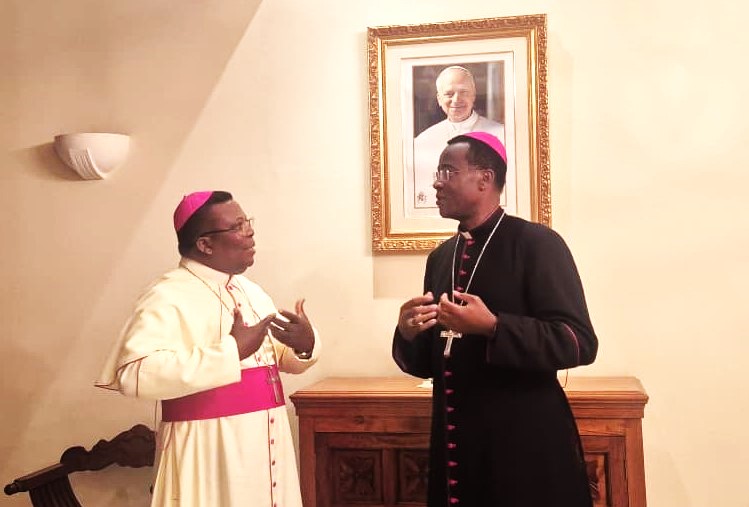
Speaking at the sidelines of the Second African Climate Summit in Addis Ababa (Ethiopia), Most Rev. Coffi Roger Anoumou, Bishop of Lokossa, Benin, who led the delegation of the Symposium of Episcopal Conferences of Africa and Madagascar (SECAM), briefed the Apostolic Nuncio to Ethiopia, Archbishop Brian Ngozi Udaigwe, on the Church’s position.
On Tuesday September 9, 2025, Apostolic Nuncio to Ethiopia Archbishop Udaigwe received Bishop Anoumou, head of SECAM delegation at the Second African Climate Summit, from 8 to 10 September 2025 in Addis Ababa. The Ambassador of the Holy See welcomed the representative of the African episcopate and expressed joy at the Church’s presence in the continental climate dialogue.
During this audience, Bishop Anoumou of Lokossa, Benin, presented SECAM’s position on climate change, describing the crisis as both an ecological and moral emergency. The African Church highlighted that the continent, despite contributing the least to global emissions, suffers the most severe consequences – including droughts, floods, cyclones, and desertification.
Africa: Architect of its ecological future
On Sunday, September 7, during a Mass for the Care of Creation at the Holy Saviour Parish in Addis Ababa, Bishop Roger Anoumou read the SECAM statement, in which African bishops called for urgent, equitable, and African-led responses that prioritize justice and the dignity of vulnerable communities. African Episcopate emphasized on key priorities outlined including Africa-led solutions, Renewable energy, Climate finance justice, and Adaptation and resilience.
Indeed, SECAM insists that Africa must not merely be a recipient of external agendas but a full architect of its ecological future. The Church in Africa “supports renewable energy, regenerative agriculture, and appropriate technologies that protect biodiversity and respect cultural heritage”.
SECAM urges investment in decentralized, community-driven renewable energy, creating decent jobs, empowering women and youth, and reducing energy poverty while curbing carbon emissions.
“Justice, solidarity and care for creation”
Another key priority identified is the climate finance justice: urging wealthy nations to repay their “ecological debt” through transparent, non-indebting support, especially for Loss and Damage.
“Adaptation efforts must safeguard food security, water systems, and livelihoods, prioritizing the poor and marginalized”, stressed Bishop Anoumou, recalling that “faith communities stand ready to collaborate in educating, mobilizing, and accompanying affected populations”.
Bishop Anoumou underscored that climate action is a spiritual imperative, rooted in Laudato Si’ and Laudate Deum (encyclicals of the late Pope Francis). He said Africa must not be a passive recipient of global agendas but an “active agent” of its ecological transformation. “Justice, solidarity, and care for creation demand nothing less,” SECAM affirmed.
The Apostolic Nuncio to Ethiopia, Archbishop Brian Ngozi Udaigwe, originally from Nigeria, encouraged Bishop Roger Anoumou, and through him, the Bishops Members of the Symposium of Episcopal Conferences of Africa and Madagascar (SECAM) “to continue strengthening advocacy for the care of creation”.
Charles Ayetan