SECAM et les évêques allemands partagent les conclusions de la réunion d'une semaine à Madagascar
SECAM et les évêques allemands partagent les conclusions de la réunion d'une semaine à Madagascar
CANAA || Par le Père Don Bosco Onyalla, Nairobi || 04 juin 2018
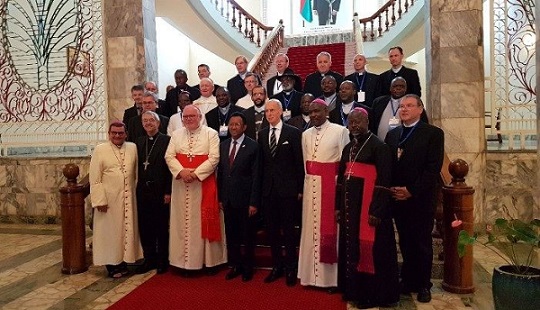
 Les représentants de la Conférence épiscopale allemande et ceux du Symposium des Conférences épiscopales d'Afrique et de Madagascar (SECAM) ont partagé leurs points de vue sur leur rencontre d'une semaine (22-27 mai 2018), qui s'est déroulée à Antananarivo, Madagascar.
Dans un message à la fin de leur rencontre, les chefs de l'Église ont partagé comment, au cours de leur rencontre, ils avaient « appris davantage sur le développement dans les temps modernes et surtout sur ce que la Doctrine sociale catholique enseigne sur le développement humain intégral », soulignant le thème de leur rencontre.
« Nous avons partagé des expériences personnelles et une compréhension du développement humain intégral et, en particulier, de sa pertinence inséparable pour la mission d'évangélisation de l'Église », ont poursuivi les évêques dans leur message collectif envoyé à la CANAA.
« Dans nos discussions, nous ne pouvions que convenir qu'en tant qu'Eglise, tant en Afrique qu'en Allemagne, l'Esprit Saint ouvre les yeux sur le fait que nous avons encore beaucoup à faire dans notre mission d'évangélisation », ont déclaré les dirigeants de l'Eglise.
Voici le texte intégral du message collectif des évêques, qui comprend sept résolutions.
MESSAGE DE LA HUITIÈME RÉUNION ALLEMAGNE-AFRICAINE DES BISHOPS.
(Antananarivo, 22-27 mai 2018.)
Bonjour. La grâce et la paix de notre Seigneur et Sauveur Jésus-Christ soient avec vous tous. Chers frères et sœurs et vous tous, hommes et femmes de bonne volonté, du 22 au 27 mai 2018, nous, représentants de la Conférence épiscopale allemande et du Symposium des Conférences épiscopales d'Afrique et de Madagascar (SECAM) nous sommes réunis à Antananarivo, la capitale de la République de Madagascar. C'est la huitième réunion de cet organe à la recherche d'une plus grande communion et collaboration au sein de nos Eglises locales, qui a commencé dans les années 1980 afin de partager connaissances et expériences et de mieux servir la mission d'évangélisation confiée à l'Église par Notre-Seigneur et Sauveur Jésus-Christ (voir Mt 28,18-20).
Le thème de cette réunion était : Développement humain intégral, nécessité par les développements socioculturels (certains positifs et d'autres négatifs) de la sécularisation et de la mondialisation que traverse le monde de nos jours, et également inspiré par la doctrine sociale catholique de nos papes au cours des cinquante dernières années, en particulier Populorum Progressio de 1967 par le bienheureux Pape Paul VI, dans lequel il a donné une définition critique du développement, par le Pape Benoît XVI, Caritas en véritable 2009 et la récente Encyclique Laudato Si de 2015 par le Pape François.
En tant qu'Evêques, nous avons pris le temps de prier et de solliciter la grâce divine de célébrer quotidiennement la Sainte Eucharistie, dont une mémorable fut la Messe d'ouverture avec les évêques de la Conférence épiscopale de Madagascar à la paroisse Saint François Xavier, Antananarivo, et la participation du Peuple de Dieu. Nous profitons de nouveau de cette occasion pour féliciter Son Éminence Désir TSARAHAZANA, Archevêque de Toamasina, pour son élévation en tant que Cardinal.
Au cours de notre rencontre, nous avons eu le privilège d'avoir une audience avec le Président de la République de Madagascar, Son Excellence Hery RAJAONARIMAMPIANINA à la présidence, et de l'informer de notre présence et de notre but à Madagascar. Il a à son tour partagé avec nous quelques points de vue sur notre thème et son pays. Nous avons également pris le temps de visiter certains sites du pays pour voir la beauté de la création de Dieu et de nous familiariser avec certains des défis du développement du peuple.
Au cours de notre rencontre, nous avons appris davantage sur le développement dans les temps modernes et plus particulièrement sur ce que la Doctrine sociale catholique enseigne sur le "Développement humain intégral". Nous avons partagé des expériences personnelles et la compréhension du développement humain intégral et, en particulier, sa pertinence inséparable à la mission d'évangélisation de l'Église. Notre Seigneur et Sauveur Jésus-Christ est venu pour que l'humanité ait la vie et la plénitude (voir Jn. 10:10). Nous sommes reconnaissants à Dieu pour ce moment de grâce, et nous partageons ici quelques-unes de nos délibérations, réflexions et résolutions avec vous, cher Peuple de Dieu dans nos Eglises locales d'Allemagne et d'Afrique, et avec tous les hommes et femmes de bonne volonté du monde entier.
Le développement humain intégral dans la mission d'évangélisation de l'Église: Dans l'Église Doctrine sociale, le bienheureux Paul VI, dans Populorum Progressio a enseigné que: "Le développement ne peut se limiter à la seule croissance économique. Pour être authentique, elle doit être complète : intégrale, c'est-à-dire qu'elle doit promouvoir le bien de toute personne et de toute personne ».
Pour être complet et intégral, le développement humain doit assurer le bien-être total de la personne, de chaque personne et de toute société humaine. Elle doit impliquer la croissance soutenue de chacun, en veillant à ce qu'il puisse entretenir des relations justes et pacifiques dans un environnement florissant de plénitude culturelle, politique, économique, sociale et spirituelle, entre autres. Cet ensemble devrait également inclure le bien-être de sa famille, de sa société et de sa nature. En fait, elle doit aussi garantir le respect du caractère sacré de la vie humaine, de la dignité de chaque personne et de l'intégrité de la création, que le pape François appelle « notre maison commune » à Laudato Si.
Nous sommes très convaincus qu'en tant qu'Evêques d'Allemagne et d'Afrique envoyés par le Christ pour apporter la Bonne Nouvelle du salut à tous les peuples jusqu'à la fin de la terre (voir Mt 28,18-20), nous devons renouveler notre zèle missionnaire en travaillant pour le développement humain intégral en tant que partie indispensable de notre mandat, et donc nous vous invitons tous nos clergés et religieux, les femmes et les hommes laïcs, les jeunes et les enfants, les professionnels de tous les secteurs de l'effort humain et de la direction sociopolitique et traditionnelle à contribuer à cette œuvre visant à apporter à toutes les personnes la plénitude de la vie que le Christ est venu accomplir.
Dans nos discussions, nous ne pouvions que convenir que l'Église, en Afrique comme en Allemagne, ouvre les yeux sur le fait que nous avons encore beaucoup à faire dans notre mission d'évangélisation. Juste un regard décontracté sur la situation en Afrique et ce qui nous regarde en face est la pauvreté, la misère, la maladie et le désespoir au milieu de Dieu des dons abondants de ressources humaines et naturelles; ce sont des maux causés par l'avidité humaine et la corruption, les injustices de toutes sortes et la violence et les guerres fratricides, etc. La situation de l'Europe nous préoccupe également de la pénurie de valeurs spirituelles, de matérialisme et de consumérisme excessifs, d'individualisme, de peu ou pas de respect pour la vie et les droits des à naître, des personnes âgées et des infirmes, etc. Tous ces maux, qu'ils soient en Afrique ou en Europe, montrent que nous avons encore beaucoup à faire en tant qu'Église dans notre mission d'évangélisation.
Ce n'est pas simplement l'annonce de la Bonne Nouvelle de Jésus-Christ à tous, mais aussi le travail d'approfondissement de notre formation chrétienne et la formation de consciences de nos dirigeants politiques et socio-économiques, ainsi que l'offrande de véritable témoignage de notre foi en Jésus-Christ en tant que Seigneur et Sauveur de tous les hommes et femmes, croyants ou non.
L'évangélisation doit conduire tous à comprendre et développer leur vie de relations avec Dieu, avec leurs semblables, femmes et hommes, et avec la création. Ce travail de relation exige que nous collaborions avec toutes les femmes et tous les hommes de bonne volonté afin de créer un monde nouveau et meilleur pour que tous aient la chance de développer leurs talents au mieux de leurs capacités et de les amener à servir chaque corps, vivant et même à naître.
Résolutions : Les aspects suivants pour la promotion du développement humain intégral sont particulièrement importants pour nos résolutions :
1. Nous renouvelons notre engagement à œuvrer pour un monde plus juste avec toutes les femmes et tous les hommes de bonne volonté. Tous les êtres humains ont le droit de vivre une vie décente. Leurs besoins fondamentaux doivent être assurés, tels que l'accès à une alimentation adéquate, à l'eau potable, à l'éducation et au soutien médical. Tous ont droit à un accès égal aux marchés, à des conditions de travail humaines et à des services sociaux de base, ainsi qu ' à la possibilité de participer à la prise de décisions politiques et à leur mise en œuvre.
2. Cette voie sociale et économique de développement de l'humanité doit respecter les limites écologiques de notre planète terre, notre foyer commun. Sans un contrôle efficace du changement climatique, les possibilités offertes aux pays pauvres et aux pays pauvres en particulier seraient considérablement réduites. Le Pape François nous appelle d'urgence à entendre « le cri de la terre et le cri des pauvres » (LS 48) !
3. Les obstacles au développement intégral se retrouvent dans chaque pays et sur la scène internationale. Nous défendons un ordre mondial plus juste, en particulier en ce qui concerne le commerce international qui offre les mêmes possibilités à tous les pays et à tous les peuples.
4. Le développement intégral ne peut être couronné de succès que si la discrimination à l ' égard des personnes, en particulier des femmes, est éliminée. L ' autonomisation de toutes les femmes dans le monde et dans tous les domaines de la société est une condition préalable nécessaire au développement de chaque personne et de l ' humanité tout entière.
5. En tant qu'Église en Afrique et en Europe, nous nous engageons à faire en sorte que notre mission et notre travail d'évangélisation soient inséparablement liés aux exigences du développement humain intégral: Pas d'évangélisation sans efforts de développement ! Les objectifs du développement humain intégral doivent résonner dans tous les aspects de la vie de l'Église – dans les questions liturgiques, dans notre catéchisme, l'éducation, le bien-être et le travail social. Dans nos universités, facultés de théologie et de philosophie, séminaires et écoles catholiques, nous allons promouvoir l'enseignement de la Doctrine sociale catholique afin de permettre aux prêtres, religieux et laïcs de promouvoir le développement humain intégral de toutes les personnes, toujours et partout.
6. Nous nous engageons à défendre le développement humain intégral dans nos propres pays et sur la scène internationale de manière encore plus efficace et plus convaincante qu ' auparavant. L'Eglise est une institution mondiale, un acteur mondial, offrant des opportunités qui doivent être utilisées résolument – en priorité au bien-être des pauvres et à l'intégrité de la création.
7. Nous nous engageons à poursuivre ce dialogue, cette coopération et cette communion entre l'Église en Afrique et en Allemagne. Le SECAM et la Conférence épiscopale allemande élaboreront un programme de suivi de notre rencontre avec Antananarivo afin de réaliser notre vision commune et nos propositions concrètes dans l'Eglise et la société. Les agences de l'Eglise en Allemagne et leurs homologues en Afrique (SECAM) seront impliqués dans ce processus et engageront les capacités scientifiques et professionnelles nécessaires des deux côtés. En outre, nous attendons avec impatience la prochaine réunion des évêques africains et allemands pour un dialogue et un échange encore plus fructueux vers une plus grande collaboration et communion ecclésiales.
Nous sommes reconnaissants pour la communion fraternelle et la plus grande compréhension entre nous et en tant que représentants de nos Eglises locales. Lors de cette rencontre à Antananarivo, nous avons pris conscience de la richesse et des opportunités uniques qui caractérisent notre Église, universelle et globale. Nous sommes une communauté mondiale et une communion d'apprentissage, de prière et de solidarité, envoyée pour être témoins de foi, d'espérance et d'amour pour le monde entier. Ce faisant, nous servons le développement intégral de chaque personne et de toute la personne humaine.
Tout en confiant ce mess à la sollicitude maternelle de la Très Sainte Vierge Marie, Mère de l'Eglise, nous disons: "A Dieu soit la gloire, il a fait de grandes choses! Il fera de plus grandes choses pour tous ses enfants!»
Signé :
Son Excellence Mgr Gabriel MBILINGI
Archevêque de Lubango, Angola
Président du SECAM.
Son Eminence Reinhard Cardinal MARX
Archevêque de Munich-Freising, Allemagne
Président de la Conférence épiscopale allemande.
Dimanche 27 mai 2018.